Quick Answer: Online bookkeeping services usually charge in one of five ways: hourly rates, flat monthly fees, tiered packages, per-transaction fees, or value-based pricing. Most small businesses pay between $200 and $2,500 per month. The right choice depends on your transaction volume, business size, and whether you also need payroll support.
Running a business in Pompano Beach, Boca Raton, or Deerfield Beach means juggling invoices, receipts, taxes, and payroll often all at once. At JL Bookkeeping FL LLC, we work with local business owners every day who ask the same question: “How much should I really be paying for bookkeeping?” This guide breaks down every pricing model in plain language, compares real costs, and shows you exactly how to pick the model that fits your business.
What Are Online Bookkeeping Services?
Online bookkeeping services are remote accounting support that tracks your income, expenses, and financial records using cloud software instead of paper files or in-person visits. A bookkeeper logs into secure software like QuickBooks Online or Xero, reconciles your bank accounts, and sends you monthly reports.
Online bookkeeping typically includes:
- Recording daily income and expenses
- Reconciling bank and credit card accounts
- Categorizing transactions correctly
- Preparing monthly profit and loss statements
- Tracking accounts payable and receivable
- Preparing your books for tax season
Many providers also offer online payroll services as an add-on, which matters for businesses with even one or two employees. Unlike a traditional in-house bookkeeper who works from a physical office, an online bookkeeping team collaborates through shared cloud dashboards, secure document uploads, and video or phone check-ins so you get the same level of support without the overhead of a full-time salaried position.
What Are the Different Pricing Models for Online Bookkeeping Services?
There are five common pricing models for online bookkeeping services: hourly billing, flat monthly fees, tiered packages, per-transaction pricing, and value-based pricing. Each model fits a different type of business.
1. Hourly Pricing
Hourly pricing charges you for the exact time a bookkeeper spends on your books. In 2026, hourly rates for virtual bookkeepers typically range from $30 to $90 per hour, while local CPA firms may charge $50 to $120 per hour.
Best for: Businesses with very simple, low-volume books, or one-time cleanup projects.
Watch out for: Costs that swing month to month, making budgeting harder.
2. Flat Monthly Fee (Subscription Pricing)
This is the most common model for online bookkeeping services today. You pay one predictable price every month, no matter how many hours the work actually takes. Flat monthly fees usually range from $200 to $2,500 per month, with most small businesses landing between $300 and $900.
Best for: Business owners who want predictable costs and hate surprise invoices.
Watch out for: Some flat fees cap your transaction volume — going over the limit can trigger extra charges.
3. Tiered Package Pricing
Tiered pricing groups services into “Basic,” “Standard,” and “Premium” packages. Each tier adds more services, such as payroll coordination, sales tax filing, or a dedicated account manager.
Typical tier structure:
- Basic ($150–$400/month): Bank reconciliation, transaction categorization, simple P&L report
- Standard ($400–$800/month): Everything in Basic plus accounts payable/receivable and monthly financial statements
- Premium ($800–$2,000+/month): Everything in Standard plus payroll coordination, sales tax filing, and a dedicated bookkeeper
Best for: Growing businesses that expect to need more services within a year.
4. Per-Transaction (Volume-Based) Pricing
This model charges a small base fee plus a per-transaction cost, often a few cents to a dollar per transaction. It works well for businesses whose sales swing sharply by season.
Best for: E-commerce sellers, seasonal businesses, or contractors with unpredictable invoice volume.
Watch out for: A busy month can produce a much higher bill than you expect.
5. Value-Based Pricing
Value-based pricing sets a price based on the outcome or complexity of the work, not the hours logged. A bookkeeper handling a business with multiple entities, inventory, and payroll may charge more than one handling a simple service business, even if the hours are similar.
Best for: Complex businesses that need strategic financial insight, not just data entry.
Comparison Table: Online Bookkeeping Pricing Models
| Pricing Model | Typical Cost | Best For | Predictability |
|---|---|---|---|
| Hourly | $30–$120/hour | Simple books, one-time cleanup | Low |
| Flat Monthly Fee | $200–$2,500/month | Most small businesses | High |
| Tiered Package | $150–$2,000+/month | Growing businesses | High |
| Per-Transaction | Base fee + $0.05–$1/transaction | Seasonal or e-commerce businesses | Medium |
| Value-Based | Custom quote | Complex, multi-entity businesses | Medium |
How Much Do Online Bookkeeping Services Cost on Average?
Online bookkeeping services cost an average of $200 to $2,500 per month for small businesses, depending on transaction volume, payroll complexity, and reporting needs. Most businesses with 100–300 monthly transactions pay between $300 and $900 per month.
Here is what actually drives that number:
- Basic bookkeeping (bank reconciliation, categorization, simple reports): $200–$500/month
- Full-charge bookkeeping (adds accounts payable/receivable, payroll coordination, formal monthly close): $500–$2,000/month
- Controller-level service (adds forecasting, budgeting, strategic advice): $2,000–$5,000/month
For comparison, hiring a full-time in-house bookkeeper costs roughly $45,000 to $60,000 per year in salary alone before payroll taxes, benefits, software, and office space. That works out to $3,500 or more per month, which is why so many small businesses in South Florida now choose outsourced or online bookkeeping instead.
Most providers also require an accounting software subscription. QuickBooks Online runs about $30–$90 per month, and Xero runs about $15–$78 per month. Some online bookkeeping services, like Bench or Pilot, bundle this software cost into your monthly retainer, so always check whether it’s included before comparing quotes.
What Factors Affect Online Bookkeeping Pricing?
Six main factors affect how much you pay for online bookkeeping services: transaction volume, number of accounts, payroll needs, industry complexity, cleanup work, and reporting requirements.
- Transaction volume – More sales, purchases, and invoices mean more work each month.
- Number of bank and credit card accounts Reconciling five accounts takes longer than reconciling one.
- Payroll complexity – Businesses that run payroll, especially with multiple employees or contractors, usually pay more because payroll adds tax filing and compliance steps.
- Industry type – Construction, real estate, and trucking businesses often need job costing or project-based reports, which cost more than simple service-based bookkeeping.
- Catch-up or cleanup work – If your books are behind, expect a separate one-time fee, often several hundred to several thousand dollars, before monthly bookkeeping can start.
- Reporting depth – Basic profit and loss reports cost less than detailed job-cost reports, cash flow forecasts, or multi-entity consolidated statements.
Businesses with inventory, multiple locations, or sales tax obligations for Online Bookkeeping Services Pompano Beach, Boca Raton, and Deerfield Beach should expect to land on the higher end of these ranges.
Which Cost Model Is Best for Small Businesses?
A flat monthly fee is usually the best cost model for small businesses because it offers predictable pricing, simple budgeting, and no surprise invoices. This model works especially well for service businesses, retail shops, and solo entrepreneurs with fewer than 300 transactions per month.
Here’s a simple way to decide:
- Fewer than 100 transactions a month, one bank account: A basic flat monthly plan ($150–$400) is usually enough.
- 100–300 transactions, some payroll: A standard tiered plan ($400–$800) fits better.
- Seasonal spikes in sales: Consider per-transaction pricing so you’re not overpaying during slow months.
- Complex, multi-entity business: Value-based pricing with a dedicated bookkeeper is worth the extra cost.
Which Cost Model Works Best for Construction and Contracting Businesses?
Construction and contracting businesses usually need a tiered or value-based pricing model because their bookkeeping involves job costing, subcontractor payments, equipment expenses, and often multiple employees on payroll. A flat basic plan rarely covers these needs.
At JL Bookkeeping fl, we see this pattern often in Pompano Beach, Boca Raton, and Deerfield Beach: contractors start with a simple flat-fee plan, then outgrow it within months once they add crew members, subcontractors, or multiple job sites. A tiered package that scales with the business and includes payroll coordination usually saves money in the long run compared to constantly renegotiating a flat fee.
Construction bookkeeping typically needs:
- Job costing to track profit per project
- Progress billing support for milestone-based invoices
- 1099 tracking for subcontractors
- Payroll tax filing support for crew wages
- Equipment and vehicle expense tracking
How Do Online Bookkeeping Services Work With Payroll Services?
Online bookkeeping and online payroll services work together because payroll transactions — wages, tax withholdings, and benefit deductions must be recorded accurately in your books every pay period. Many online bookkeeping providers offer payroll as an add-on service or partner with a dedicated payroll provider.
If your bookkeeper doesn’t handle payroll, you’ll need a separate payroll service or software that connects to your accounting platform. This keeps your financial reports accurate and prevents payroll errors from creating tax problems down the line.
What Is Payroll Optimization and Why Does It Matter?
Payroll optimization means streamlining how you calculate, pay, and report employee wages so you save time and avoid costly mistakes. It matters because payroll errors are one of the most common and expensive problems small businesses face.
Payroll optimization typically includes:
- Automating tax calculations so you never miscalculate FICA, federal, or state withholdings
- Syncing time-tracking software directly with payroll to avoid manual entry errors
- Reviewing your pay schedule (weekly vs. biweekly vs. monthly) to reduce processing fees
- Bundling payroll with bookkeeping so wage data flows directly into your financial reports
- Auditing your payroll setup once a year to catch overpayments or missed deductions
Businesses that optimize payroll often reduce administrative time by several hours each month and lower their risk of IRS penalties.
What Are the Best Practices for Payroll Tax Filing?
Payroll tax filing best practices include filing on time, double-checking employee classification, keeping accurate wage records, and using software or a service that automates federal and state filings. Missing a payroll tax deadline can trigger penalties starting at a percentage of the unpaid tax, growing the longer it goes unresolved.
Key payroll tax filing best practices:
- File and deposit on schedule. The IRS requires payroll tax deposits on a monthly or semi-weekly schedule based on your deposit history.
- Classify workers correctly. Misclassifying an employee as an independent contractor is one of the most common and costly payroll mistakes.
- Keep four years of payroll records. This includes wages, tax deposits, and employee forms like W-4s and I-9s.
- Reconcile payroll to your books every pay period. This catches errors early instead of at year-end.
- Use automated payroll tax filing through your payroll provider whenever possible to reduce manual errors.
- Review state-specific requirements, since Florida businesses handle state reemployment tax even though Florida has no state income tax.
How Do I Find Payroll Services Near Me?
To find reliable payroll services near me, start by searching for providers with local experience, checking reviews from businesses in your industry, and asking whether they bundle payroll with bookkeeping. Local knowledge matters because payroll rules can shift based on state unemployment tax rates and local business requirements.
When comparing advance payroll services near me, ask each provider:
- Do you offer same-day or next-day direct deposit?
- Is tax filing included, or billed separately?
- Can you handle multi-state employees if I expand?
- Do you integrate with my existing bookkeeping software?
- What happens if a payroll tax deadline is missed who’s responsible?
Why Do Businesses in Pompano Beach, Boca Raton, and Deerfield Beach Need Local Bookkeeping and Payroll Support?
Businesses in Pompano Beach, Boca Raton, and Deerfield Beach need bookkeeping and payroll support that understands Florida’s specific tax rules, seasonal tourism cycles, and the mix of construction, retail, and service businesses common in South Florida. Even with online services, local familiarity helps avoid costly mistakes.
South Florida businesses face a few unique factors:
- No state income tax, but reemployment tax still applies to payroll
- Seasonal revenue swings tied to tourism and snowbird populations
- A high concentration of construction and contracting businesses, which need job-costed bookkeeping
- Multiple nearby tax jurisdictions, since Pompano Beach, Boca Raton, and Deerfield Beach sit close together but may have different local licensing or permitting costs
What Payroll Services Are Available in Deerfield Beach?
Payroll services in Deerfield Beach typically include software-based payroll for small teams, full-service payroll processing, and bundled bookkeeping-payroll packages designed for construction, retail, and hospitality businesses common in the area. Business owners in Deerfield Beach often need payroll that can handle both hourly crews and salaried office staff in a single system.
What Payroll Services Are Available in Boca Raton?
Payroll services in Boca Raton range from basic payroll software for solo entrepreneurs to full-service payroll and HR support for larger companies, reflecting the wide range of business sizes in the city. Boca Raton’s mix of professional services and growing small businesses means providers here often offer stronger HR add-ons, like benefits administration, alongside standard payroll.
What Are the Best Payroll Services for a Small Business?
The best payroll services for a small business combine automated tax filing, direct deposit, an easy-to-use dashboard, and integration with your bookkeeping software. Look for a provider that scales with you, since switching payroll providers mid-year can create messy tax filings.
Signs of a strong payroll provider:
- Automatic federal and state tax filing
- Same-day or next-day direct deposit options
- Clear, flat pricing without hidden per-run fees
- Integration with QuickBooks, Xero, or your bookkeeping provider
- U.S.-based customer support during business hours
What Is the Difference Between Bookkeeping and Accounting?
Bookkeeping is the daily recording of financial transactions, while accounting is the broader process of analyzing, interpreting, and reporting on those records, often including tax strategy and financial planning. Bookkeepers keep your data accurate; accountants use that data to guide business decisions.
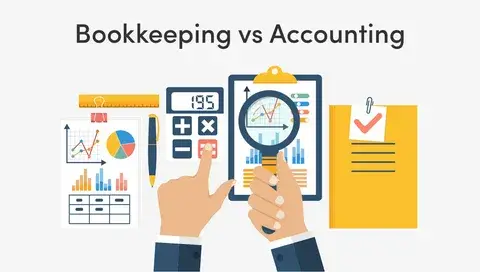
Here’s how the two roles usually split:
- Bookkeeper: Records transactions, reconciles accounts, categorizes expenses, produces basic reports
- Accountant/CPA: Reviews financial statements, files taxes, advises on deductions, plans for growth or major purchases
Many online bookkeeping services stop at the bookkeeping level and refer clients to a CPA for tax filing. Others, especially higher-tier plans, include light accounting support like quarterly tax estimates. When comparing providers, ask directly whether tax filing is included or handled by a separate accountant, since this affects your total annual cost.
What Software Do Online Bookkeeping Services Use?
Online bookkeeping services typically use cloud accounting software such as QuickBooks Online, Xero, or Wave, connected to payroll platforms like Gusto, ADP, or Paychex. These tools let a remote bookkeeper securely access your financial data, reconcile accounts, and generate reports without ever needing to visit your office.
Common tools in an online bookkeeping and payroll stack:
- QuickBooks Online or Xero – core bookkeeping software
- Gusto, ADP, or Paychex – payroll processing and tax filing
- Bill.com or Melio – accounts payable automation
- Expensify or Dext – receipt tracking and expense capture
- Plaid or direct bank feeds – automatic transaction imports
For a construction business, job-costing add-ons like QuickBooks Online Advanced or industry-specific software may also be part of the stack. Ask any provider which software they use and whether you retain full ownership of your data if you switch providers later — this matters more than most business owners realize.
What Common Mistakes Do Businesses Make When Choosing a Bookkeeping Service?
The most common mistakes businesses make when choosing an online bookkeeping service are picking the cheapest option without checking what’s included, ignoring payroll compatibility, and failing to ask about cleanup or catch-up fees before signing up.
Watch out for these five mistakes:
- Choosing price over scope. A $150/month plan that excludes payroll coordination and accounts payable may cost more once you add those services separately.
- Not asking about software costs. Some quotes exclude the QuickBooks or Xero subscription, adding $30–$90 per month to your real cost.
- Skipping the cleanup conversation. If your books are behind, expect a one-time catch-up fee before monthly service starts. Providers who don’t mention this upfront often surprise clients later.
- Ignoring payroll integration. If your bookkeeping and payroll systems don’t talk to each other, you risk double entry, mismatched reports, and tax filing errors.
- Not checking response times. Some online-only providers take days to respond to questions. For time-sensitive issues like a payroll tax notice, that delay can be costly.
How Do You Switch to a New Online Bookkeeping or Payroll Provider?
Switching to a new online bookkeeping or payroll provider involves exporting your historical data, confirming your books are reconciled through the switch date, and setting up payroll with the new provider before your next pay run. Most switches take two to four weeks when handled correctly.
Steps for a smooth switch:
- Request a final reconciliation from your current provider through the cutoff date.
- Export historical reports profit and loss, balance sheet, and payroll records for at least the current year.
- Confirm software access, since some providers own the QuickBooks or Xero subscription rather than you.
- Set up payroll with the new provider early, ideally two full pay cycles before your first live run, to avoid missed tax deposits.
- Notify the IRS and state agencies of any change in your payroll tax filer of record, if applicable.
- Run a parallel check on your first payroll cycle with the new provider to confirm wages and withholdings match your records.
Businesses that time a switch around a natural break point like the start of a new quarter or fiscal year — usually avoid the most reporting headaches.
How Do You Choose the Right Bookkeeping Cost Model for Your Business?
Choosing the right bookkeeping cost model comes down to matching the pricing structure to your transaction volume, growth plans, and payroll needs. Follow this simple checklist:
- Count your monthly transactions. Under 100 favors a basic flat fee. Over 300 favors a tiered or value-based plan.
- Decide if you need payroll bundled in. If you have employees, look for a provider that includes or partners for payroll.
- Think about seasonality. If your revenue swings widely by season, per-transaction pricing may save money.
- Check for job costing needs. Construction and contracting businesses almost always need tiered or value-based pricing.
- Compare total cost, not just the sticker price. Ask whether software, tax filing, and payroll are included or billed separately.
- Start smaller than you think you need. You can always upgrade a tier but downgrading mid-contract is harder.
Comparison Table: Bookkeeping + Payroll Bundle Options
| Business Type | Recommended Bookkeeping Model | Recommended Payroll Add-On | Estimated Monthly Cost |
|---|---|---|---|
| Solo entrepreneur, no employees | Basic flat fee | None needed | $150–$400 |
| Small retail or service business | Standard tiered plan | Basic online payroll software | $400–$800 + $60–$150 |
| Construction/contracting business | Tiered or value-based | Full-service payroll with tax filing | $800–$2,000 + $150–$650 |
| Seasonal or e-commerce business | Per-transaction pricing | Flexible payroll software | Base fee + volume cost |
| Multi-entity or high-complexity business | Value-based, controller-level | Full-service payroll + HR support | $2,000–$5,000 + custom |
What Does a Real-World Bookkeeping and Payroll Budget Look Like?
A real-world bookkeeping and payroll budget for a small business with five to ten employees typically lands between $700 and $1,500 per month when both services are combined. Seeing the numbers side by side makes it easier to plan.
Example: A small contracting business with 8 employees
- Standard tiered bookkeeping plan (job costing, AP/AR, monthly close): $650/month
- QuickBooks Online subscription: $70/month
- Full-service payroll for 8 employees (base fee + per-employee cost): $150–$250/month
- Payroll tax filing: included in full-service payroll
- Estimated total: $870–$970/month
Example: A solo service business with no employees
- Basic flat-fee bookkeeping plan: $250/month
- Accounting software subscription: $30/month
- Payroll: not applicable
- Estimated total: $280/month
Seeing these numbers laid out helps business owners avoid comparing a bare-bones quote against a full-service one. Always ask for an itemized breakdown so you’re comparing complete costs, not just the advertised starting price.
Is It Cheaper to Bundle Bookkeeping and Payroll With One Provider?
Bundling bookkeeping and payroll with one provider is often cheaper and more accurate than hiring two separate providers, since it eliminates duplicate software costs and reduces the risk of mismatched records. Many providers also offer a discount when you combine services.
Benefits of bundling:
- One monthly invoice instead of tracking two separate bills
- Fewer reconciliation errors, since payroll data flows directly into your books
- Faster support, because one team has full visibility into both your finances and payroll
- Often a lower combined price than paying full retail for each service separately
The main trade-off is flexibility if you’re unhappy with the payroll side, you may need to renegotiate the whole bundle rather than swapping just one piece. For most small businesses in Pompano Beach, Boca Raton, and Deerfield Beach, the time savings and accuracy of a bundled provider outweigh that trade-off.
Frequently Asked Questions
Q: How much do online bookkeeping services cost per month? A: Most small businesses pay between $200 and $2,500 per month, with $300–$900 being typical for businesses with moderate transaction volume.
Is a flat monthly fee better than hourly bookkeeping pricing?
A: For most small businesses, yes. A flat monthly fee offers predictable budgeting, while hourly pricing can create unpredictable invoices from month to month.
Do online bookkeeping services include payroll?
Some do, either bundled into a premium tier or offered through a payroll partner. Always confirm whether payroll tax filing is included or billed as an extra service.
What’s the difference between online payroll services and full-service payroll?
Online payroll services often refer to software you manage yourself, while full-service payroll means the provider calculates, files, and pays payroll taxes on your behalf.
How do I know if my business has outgrown its current bookkeeping plan?
Common signs include your bookkeeper missing deadlines, reports arriving late, new employees or subcontractors not being tracked correctly, or your transaction volume rising well past what your current tier covers. If any of these happen for two months in a row, it’s time to compare a higher tier.
Conclusion
Choosing the right cost model for online bookkeeping services doesn’t have to be complicated. If you’re a small, low-volume business, a flat monthly fee keeps things simple and predictable. If you run a construction or contracting business with payroll, subcontractors, and job costs, a tiered or value-based plan will likely serve you better. And if your books and payroll are already tangled up, bundling both services with one provider can save time, reduce errors, and keep you compliant with payroll tax filing deadlines.
The biggest mistake most business owners make isn’t picking the “wrong” pricing model, it’s not reviewing the fit at all once their business changes. A plan that worked when you had two employees may not cover you once you hire a crew, add a second job site, or start filing payroll taxes across state lines. Revisit your bookkeeping and payroll setup at least once a year, ideally at tax time, so your costs stay matched to what your business actually needs.
At JL Bookkeeping FL LLC, we help business owners across Pompano Beach, Boca Raton, and Deerfield Beach find the bookkeeping and payroll setup that actually fits how they operate not a one-size-fits-all package. If you’re ready to stop guessing what your books should cost, reach out to JL Bookkeeping FL LLC today for a straightforward, no-pressure conversation about your bookkeeping and payroll options.